
Salesforce Revenue Cloud vs. Agentforce Revenue Management: What’s the Difference?
If you’ve been evaluating the Salesforce revenue platform and noticed that some pages say “Revenue Cloud,” others say “Agentforce Revenue Management,” and a few say “Revenue Lifecycle Management”, you’re not imagining things. The platform has been renamed more than once, the documentation hasn’t fully caught up, and some of what’s being marketed as new is already available, while some of it is genuinely still being built.
This article cuts through the branding noise and gives you a grounded picture of what changed, what didn’t, and where the real gaps are when you go to implement.
The Short Answer, and Why It’s Complicated
Agentforce Revenue Management and Salesforce Revenue Cloud refer to the same underlying platform. Salesforce officially rebranded in 2025, and its own site now describes the product as “Agentforce Revenue Management (formerly Revenue Cloud).”
But if you stop there, you miss the context that actually matters for implementation decisions. The rename reflects a broader company-wide rebranding from “Cloud” product names to the “Agentforce” brand, the same shift that turned Service Cloud into Agentforce Service and Sales Cloud into Agentforce Sales. It also reflects a genuine change in the platform’s strategic direction, with AI agents being embedded into revenue workflows in ways that didn’t exist two years ago.
The catch: not everything that’s been announced is available today, not everything that’s available is enabled by default, and the self-service layer that most SaaS companies actually need still isn’t native to the platform. More on all of that below.
The Full Naming History: It’s Not Just One Rename
This is where most articles get it wrong, so let’s be precise.
The platform went through several distinct phases:
Salesforce CPQ + Billing was the original managed-package approach, powerful for quoting and billing, but built outside the core Salesforce data model, which created long-term architectural limitations.
Revenue Cloud was introduced as a broader platform brand that grouped CPQ, Billing, Subscription Management, and related capabilities under one umbrella.
Revenue Cloud Advanced (RCA), also called Revenue Cloud with the new architecture, was Salesforce’s effort to rebuild the platform natively on the core Salesforce object model, using a new pricing engine (Pricing Procedures, Decision Tables, Context Definitions) instead of the old managed package logic.
Revenue Lifecycle Management (RLM) was the name used briefly in Spring ’24 before Salesforce stepped back from it.
Agentforce Revenue Management is the current brand, introduced at Dreamforce 2025, placing the platform within Salesforce’s broader AI-agent narrative.
Why does this history matter? Because if you’re running legacy Salesforce CPQ, you are on a different architecture from Agentforce Revenue Management. Salesforce has placed legacy CPQ in end-of-sale status: no new licenses, no new features, support continues but innovation has stopped. Migration to the new architecture is a real project, not a license swap.
What the Platform Has Always Done Well
Regardless of what it’s called, the core platform has consistent strengths that have been refined over years of real deployments:
| Capability | Notes |
| Configure, Price, Quote (CPQ) | Now with constraint-based configuration instead of brittle rule chains |
| Product Catalog Management | Unified catalog supporting subscriptions, one-time, and usage-based products |
| Order Management & Orchestration | Supports complex fulfillment routing and mid-term amendments |
| Contract Lifecycle Management | Amendments, co-terming, cancellations, reinstatements |
| Subscription & Renewal Management | Asset tracking, automated renewals, churn signals |
| Billing & Invoicing | Supports consolidated billing, usage-based rating, payment collections |
| Revenue Recognition | Automated schedules aligned to contract terms |
The architectural shift to native Salesforce objects (away from the managed package) also improves API accessibility, makes integration with Data Cloud and ERP systems cleaner, and reduces the kind of technical debt that plagued complex legacy CPQ implementations.
What Agentforce Actually Adds: Honestly
Here’s where it’s important to separate what’s real today from what’s being positioned for the future.
What is genuinely usable now: Agentforce agents can handle order and asset status queries, reducing internal support tickets for RevOps teams. They can assist reps during product configuration by answering natural language questions against the product catalog and pricing history. They can surface renewal alerts and trigger task creation. These aren’t demo-only capabilities, they work in production when properly configured, with the right data quality in place.
What requires careful setup: Intelligent approval routing, consumption monitoring, and AI-assisted invoice explanation are available but not plug-and-play. They require configuring Agent Topics and Actions, defining what objects the agent can access, and, critically, flagging sensitive revenue data (deal terms, pricing, customer financials) as masked through the Einstein Trust Layer before it reaches the underlying model.
What’s still maturing: Full autonomous quote generation and end-to-end deal execution without human review are on the roadmap, but practitioners working in production orgs in 2026 generally recommend budgeting for incremental automation rather than treating Agentforce as a replacement for human judgment in complex revenue workflows. The platform’s AI quality is heavily dependent on the cleanliness of your underlying data. If your historical quoting data is inconsistent, AI-driven pricing suggestions will reflect that.
The honest framing: Agentforce for Revenue is a genuine capability layer, not just a rebrand. But it’s early in its maturity curve, and the highest-ROI use cases today are the operational ones, reducing internal ticket volume, accelerating deal desk response time, preventing missed renewals, not the fully autonomous scenarios featured in launch presentations.
The Self-Service Gap Nobody Talks About Enough
This is the part of the Revenue Cloud self-service conversation that tends to get glossed over in platform marketing.
Agentforce Revenue Management handles the back-end revenue process extremely well: quoting, contracting, billing, amendments, renewals. What it does not provide natively is a customer-facing interface where your subscribers can manage their own accounts.
Think about what your customers actually need to do: browse available plans, purchase or upgrade their subscription, add or remove seats, download invoices, update payment methods, review their contract terms, initiate a renewal. In most SaaS businesses, these are high-frequency, low-complexity interactions that shouldn’t require a support ticket or a sales rep’s involvement.
Revenue Cloud manages the data and logic behind all of these actions. The experience layer, the portal or customer account area where customers actually perform them, is not included. Building it natively on Experience Cloud requires significant configuration investment and, depending on the scope, may require additional licenses on top of your Revenue Cloud licensing.
This is a real implementation cost that doesn’t show up in platform comparisons but consistently appears in post-go-live feedback from RevOps teams: the platform works, but customers still can’t self-serve.
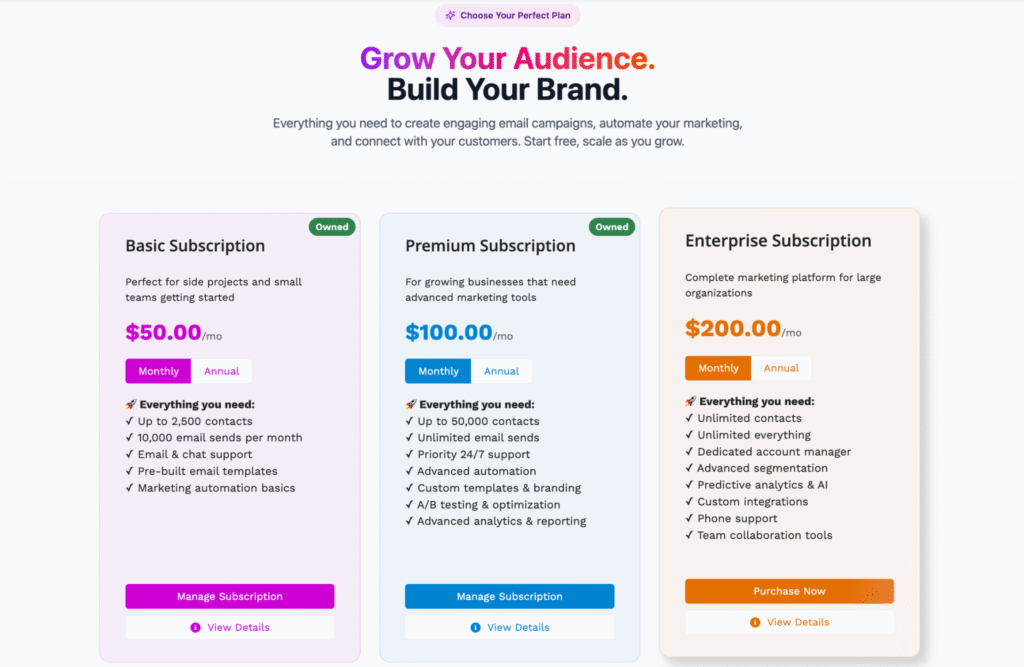
Advanced Communities addresses this directly. As a certified Salesforce Revenue Cloud implementation partner, Advanced Communities includes a purpose-built self-service subscription accelerator at no additional cost with every Revenue Cloud engagement. The accelerator gives customers a branded portal where they can browse plans, purchase subscriptions, upgrade or downgrade, manage billing terms, and download invoices, without additional licenses and without custom development. It’s particularly well-suited for companies managing a defined set of subscription tiers (typically three to ten plans) that don’t need a full ecommerce storefront, but do need clean, self-managed subscription experiences.
What Buyers and Implementation Teams Should Verify
Before signing a contract or starting a project, these are the questions that separate a well-scoped implementation from an expensive surprise:
Which modules are in your license? Agentforce Revenue Management is modular. Product Catalog, Pricing, Order Management, Contract Lifecycle, Billing, and Revenue Recognition are separate functional areas. Salesforce’s Help documentation on “Functional Area and Feature Availability in Revenue Cloud Licenses” spells out what each license tier includes. Read it before your AE call, not after.
Are you on the new architecture or the old one? If you’re coming from legacy Salesforce CPQ, you’re migrating architectures, not just upgrading a package. This has implications for your data model, your pricing logic, your integrations, and your timeline. Clarify this upfront.
Which AI agents are active, and what do they need? Agentforce agents aren’t switched on by default. Each agent capability requires configuration: defining Topics (what the agent handles), Actions (what it can execute), and Instructions (how it behaves). Some capabilities need additional licensing. Get specifics from your Salesforce account team on what’s included versus what’s a separate SKU.
What’s the self-service plan? If your customers need to manage their own subscriptions, this conversation needs to happen during scoping — not after go-live. Understand whether native Experience Cloud configuration will cover your use case, whether you’ll need B2B Commerce, or whether a partner-built accelerator is a more practical path. The cost difference between these options is significant.
What does ERP integration actually look like? Agentforce Revenue Management improves the alignment between sales and finance within Salesforce. But if your billing needs to sync with NetSuite, SAP, or another ERP, that integration requires explicit design. Don’t assume native sync.
Practical Takeaway
The simplest way to handle the Revenue Cloud renamed confusion: treat “Revenue Cloud,” “RLM,” and “Agentforce Revenue Management” as the same platform at different points in its evolution. When you encounter old documentation using the old name, it’s describing the same product. When you see current Salesforce positioning, it reflects where the platform is heading.
For evaluation, focus on three things that actually determine fit: the complexity of your pricing model, the scope of your self-service requirements, and the realism of your AI expectations.
The platform is genuinely strong at structured revenue operations: quoting, contracting, billing, renewals, and subscription lifecycle management on a unified data model. The AI additions are meaningful and growing, but the highest-value use cases today are operational, not fully autonomous. And the self-service layer that completes the customer experience needs intentional planning, it doesn’t come pre-built.
If you’re a company managing subscription revenue, and you want to see how the self-service piece can be solved without the overhead of a full commerce platform, Advanced Communities’ Revenue Cloud implementation practice includes that layer as a standard part of every engagement.
FAQ
1. Is Agentforce Revenue Management just Revenue Cloud renamed?
Partly, but the naming history is more layered than a single rename. The platform went through Salesforce CPQ, Revenue Cloud, Revenue Cloud Advanced, Revenue Lifecycle Management, and now Agentforce Revenue Management. Each step reflected a real evolution in architecture or positioning. The core product (quoting, billing, renewals, subscription management) is the same. The AI agent capabilities and the new constraint-based configuration engine are genuine additions.
2. Does Revenue Cloud still exist as a separate product?
The old legacy Salesforce CPQ is in end-of-sale status: no new licenses, no new features. The Revenue Cloud brand has been replaced by Agentforce Revenue Management in Salesforce’s current positioning. If you see “Revenue Cloud” in documentation, check the date — if it’s older, it may be referring to the legacy architecture.
3. Are Agentforce AI agents included automatically with the platform?
No. AI agent capabilities require configuration — defining what agents can access, what they can do, and how they behave. Some capabilities are included in standard licenses; others require additional entitlements. The quality of agent outputs also depends heavily on the cleanliness of your underlying Salesforce data. Budget time for setup and testing, not just enablement.
4. What should RevOps and procurement teams verify before buying?
License scope (which modules are actually included), architecture clarity (new native platform vs. legacy CPQ migration), AI agent availability and activation requirements, the self-service plan, and ERP integration design. These four areas account for the majority of scope surprises in Revenue Cloud implementations. Addressing them during scoping rather than after contract signature saves significant time and budget.