
Salesforce CPQ End of Sale: What It Means and What to Do Next
“We’re running Salesforce CPQ. Do we need to migrate right away?”
That question arrives in different forms. Sometimes it’s “Has Salesforce CPQ been discontinued?” Sometimes it’s “Can we keep operating normally for another two years?” And occasionally it comes from a CFO who just read a vendor blog post warning about a cliff edge, asking what the damage is going to be.
The immediate answer is reassuring: nothing stops working. The more useful answer takes a bit longer, and it has less to do with the product than with your own revenue model and the shape of your org.
Salesforce CPQ end of sale changes what the product will be over the next several years. It does not change whether your quoting process runs tomorrow morning. What it does change is your planning horizon. A system that no longer receives new capability can still be the right system for a while, but it stops being the place you invest in new revenue capability. That distinction is worth working through calmly, with your own architecture in front of you, rather than reacting to a date.
What Salesforce CPQ End of Sale Actually Means
End of sale is a commercial milestone. New customers can no longer purchase Salesforce CPQ licenses, while existing customers continue to receive support and can renew under their current contract terms. Salesforce describes CPQ as having moved into a maintenance phase: existing customers continue to receive support and critical fixes, while new product innovation goes into Revenue Cloud Advanced and Revenue Cloud Billing.
For a company already on CPQ, the practical picture is straightforward. Your quotes still generate. Your approval chains still fire. Your integrations still run. Salesforce has also stated that there is no forced migration, and that existing customers can continue using CPQ, renew licenses, and add users.
What changes is the roadmap. Capabilities you might have hoped would arrive natively, for example, richer consumption pricing, deeper asset lifecycle handling, or agent-ready revenue workflows, will be built elsewhere. Anything you need beyond what CPQ does today will come from custom development, a third-party package, or a different platform.
The real impact varies enormously between orgs. A company with a clean CPQ implementation, a modest product catalog, and stable annual contracts is in a very different position from one running thousands of lines of custom Apex, seven integrations, and a pricing model that changed twice since go-live. Before drawing conclusions from the announcement, it helps to know which of those you are. And because licensing and support terms can be contract-specific, confirm your own position with Salesforce or your partner rather than relying on general commentary.
End of Sale vs End of Life: Why the Difference Matters
Much of the anxiety around Salesforce CPQ comes from these two terms being used interchangeably in the market. They mean different things.
End of sale means the vendor has stopped selling the product to new customers. Existing customers keep their licenses, their support entitlement, and their renewal rights.
End of life means the product is no longer maintained. Support ends, fixes stop, and compatibility with the surrounding platform is no longer guaranteed.
Salesforce has not announced an end-of-life date for CPQ. Various analysts and consultancies have published their own predictions about when one might come, and those predictions have been repeated widely enough to sound official. They aren’t. Plan against what has actually been announced, and treat speculative timelines as background noise rather than a deadline.
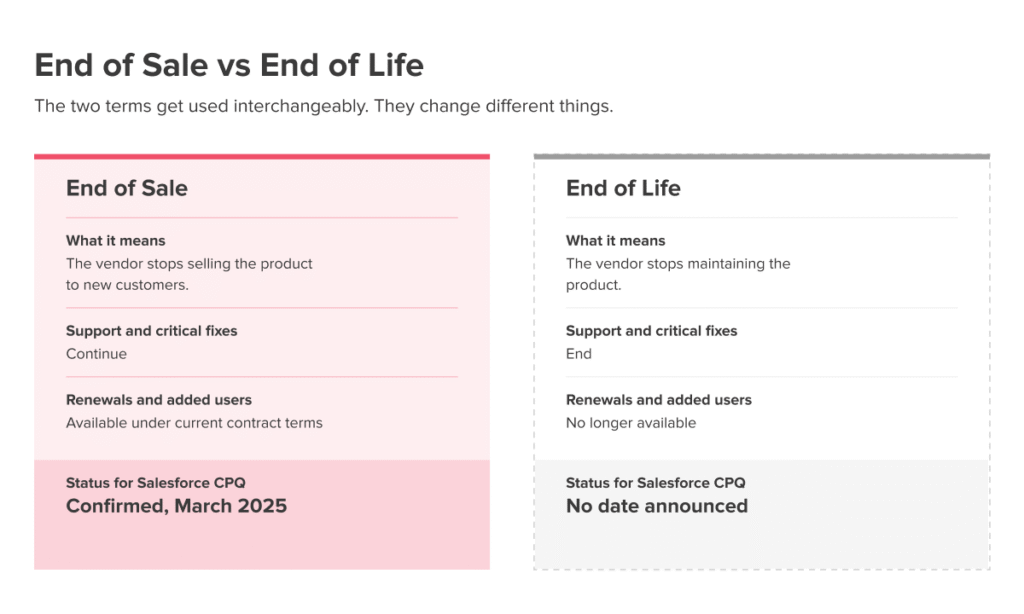
The difference matters because it determines what kind of decision you’re making. End of life forces a project. End of sale invites an assessment. Those call for very different budgets, timelines, and levels of internal urgency.
Why Salesforce Is Shifting Beyond CPQ
The move away from CPQ reflects a broader change in how companies sell. Quoting used to be the hard part. For many businesses now, quoting is the part that already works, and the difficulty sits everywhere around it.
Revenue operations today typically span pricing across direct, partner, ecommerce, and self-service channels; contract lifecycle management; subscriptions, renewals, and mid-term amendments; usage and consumption billing; order orchestration into fulfillment and ERP; and analytics that finance and sales both trust.
CPQ was designed as a quoting engine for seller-led deals. Revenue Cloud Advanced, the successor product within the Agentforce Revenue Management suite, is built natively on the Salesforce platform with an API-first, composable architecture covering product catalog, pricing, quoting, contracting, order management, asset lifecycle, amendments, and renewals exposed through Salesforce screens, APIs, partner portals, ecommerce, self-service, and agents.
That scope difference explains the strategic direction better than any announcement does. Salesforce is investing where the operational pain has moved. The two products overlap in what they do for a seller and diverge sharply underneath, which we’ve broken down in detail in our comparison of CPQ vs Revenue Cloud.
When Staying on Salesforce CPQ Still Makes Sense
Staying put is a legitimate decision, and for a meaningful number of companies it’s the correct one for now. Some signals that you’re in that group:
- Your quoting process is stable, and reps aren’t working around it.
- Your revenue model is simple: one-time sales or straightforward annual subscriptions.
- You have little usage-based or consumption complexity.
- Billing lives in a separate system, that boundary is clean, and nobody spends their week reconciling across it.
- Your team has no capacity for a transformation project in the next 12 months, and forcing one would damage more than it fixes.
- Your custom logic still earns its keep and encodes real commercial rules rather than accumulated workarounds.
If most of those describe you, the right move is to keep running, avoid adding new complexity to CPQ, and revisit the question on a defined schedule.
The Signs You’ve Outgrown CPQ
The opposite pattern tends to show up in operations rather than in the quoting screen itself:
- Quoting is fine, but everything downstream is manual: order creation, provisioning handoffs, invoicing inputs.
- Contracts, billing, renewals, and amendments live in different systems that don’t agree with each other.
- A growing layer of custom glue holds the stack together, and one or two people understand it.
- Reporting is fragmented, so sales, finance, and operations each bring their own numbers to the same meeting.
- Usage-based or hybrid pricing is already painful to model, and product management has shelved ideas because of it.
- Amendments and co-term renewals require manual intervention often enough that someone owns them as a job.
Planning is not the same as executing. It means assessment, business case, sequencing, and a phased roadmap that might span several quarters before any configuration happens. Our guide to CPQ migration planning covers how that sequencing usually works.
What Your “Next Step” Options Really Are
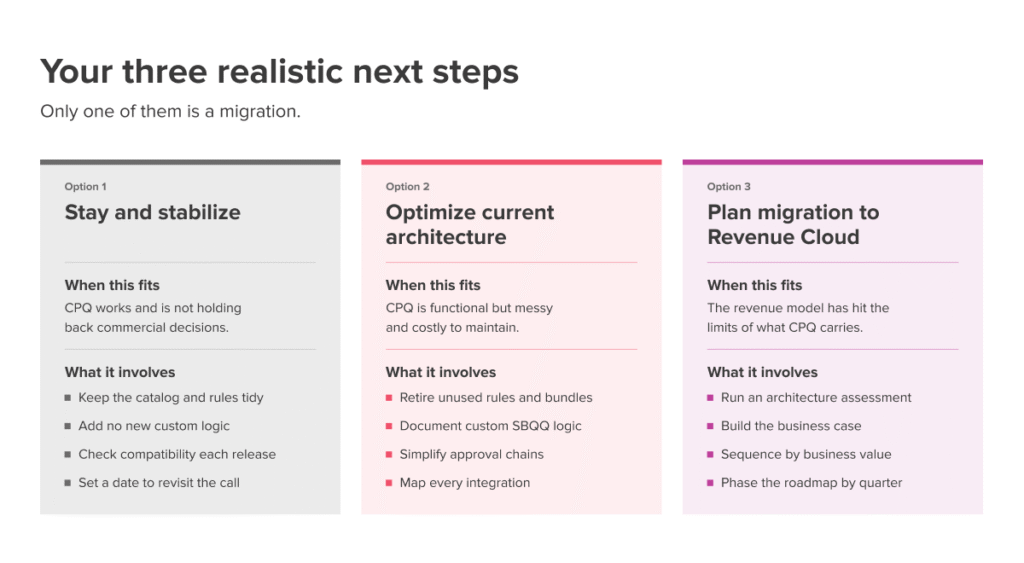
There are three realistic paths, and only one of them is a migration.
Option 1: Stay and stabilize
Appropriate when CPQ works and isn’t constraining commercial decisions. The work here is maintenance discipline: keep the catalog tidy, resist adding new custom logic, monitor package compatibility through Salesforce releases, and set a review date.
Option 2: Optimize the current architecture
For orgs where CPQ is functional but messy. Retire unused price rules and product bundles, document custom SBQQ logic properly, clean up approval chains, and map your integrations. This has immediate value and the org becomes cheaper to maintain and easier to change. It also converts a future migration from an archaeology project into a scoped one.
Option 3: Start planning a migration to Revenue Cloud
For businesses that have hit the ceiling. Planning is not the same as executing. It means assessment, business case, sequencing, and a phased roadmap that might span several quarters before any configuration happens.
Most companies we talk to belong in Option 2 right now, whether or not they eventually move.
What to Assess Before Planning a Migration
CPQ-specific objects, custom fields, pricing rules, and scripts don’t map directly to Revenue Cloud Advanced, so a structured migration and data transformation process is required. That makes the assessment phase the part that determines whether the project succeeds.
Work through:
- Pricing model: tiers, blocks, contracted pricing, multi-currency, channel-specific pricing.
- Discount and approval complexity: how many levels, how many exceptions, how much is genuinely policy.
- Contracts and amendments: co-terming, mid-term changes, split renewals.
- Subscription lifecycle: how assets, entitlements, and evergreen terms are represented today.
- Billing ownership: what sits in Salesforce, what sits in ERP or a billing platform, and who owns the boundary.
- ERP dependencies: order, invoice, and revenue recognition handoffs.
- Custom SBQQ logic: QCP scripts, triggers, and price rules, classified as business rules versus workarounds.
- Reports and dashboards tied to CPQ objects, since these break quietly and get noticed late.
- Downstream integrations: CLM, e-signature, tax, provisioning, data warehouse.
- Change management readiness: who trains the sellers, and who owns the new model afterward.
The output should be a written picture of your revenue architecture, mapped end to end rather than quote-first. Many organizations find that document valuable on its own, regardless of what they decide, because it’s the same map that any future quote-to-cash on Salesforce design would start from.
Why Revenue Cloud Is the Strategic Direction
Treating Revenue Cloud Advanced as a newer CPQ leads to poor scoping. The architecture is different in ways that matter for planning. CPQ is a managed package installed on top of Salesforce with a tightly coupled, quote-centric design, while RCA is native to core, modular, and API-first, allowing pricing, quoting, ordering, or billing to be adopted independently. The product model also shifts from SKU-based bundles to an attribute-based catalog, and pricing moves from price rules and custom scripts to declarative pricing procedures.
For businesses with subscription, consumption, or hybrid revenue models, and for those selling through more than one channel, that foundation supports things CPQ was never built to carry. For a company selling fifty products to direct customers on annual terms, the same advantages may be theoretical. Match the architecture to your commercial reality.
A Practical Decision Framework
| Scenario | Better to stay on CPQ | Better to assess Revenue Cloud |
|---|---|---|
| Simple quoting, direct sales | Yes | Not urgent |
| Subscription business | Maybe short-term | Yes |
| Complex or usage-based billing | Weak fit | Stronger fit |
| Heavy amendments and renewals | Limited | Better fit |
| Need for unified revenue operations | Weak | Strong |
| Large custom legacy footprint | Stabilize first | Plan a phased migration |
How Advanced Communities Can Help
We work with companies at every point on this spectrum, which usually starts with a CPQ architecture assessment: what you actually have, what it costs to maintain, and where it constrains the business.
From there, the work typically takes one of several shapes: migration readiness assessment, phased migration planning that sequences by business value rather than by object, full Revenue Cloud implementation, or subscription, billing, and self-service design for companies extending revenue processes to customers and partners. If you want a scoped starting point rather than an open-ended project, our Revenue Cloud Quick Start is built for that. It includes several accelerators that can elevate both sides of your business: customer-facing and internal. Here is one of them: it lets you interact with Revenue Cloud directly through WhatsApp or SMS.
Conclusion
Salesforce CPQ end of sale is not an emergency shutdown. Your system is supported, your licenses renew, and no one is switching anything off.
What the announcement does is close off one line of reasoning. “It still works” was a sufficient answer for a product with a roadmap ahead of it. The better question now is whether your current Salesforce revenue architecture fits the next stage of your business: the pricing models you want to launch, the channels you want to sell through, and the operational load you’re willing to keep carrying. Answer that honestly, and the timing decision usually answers itself.
Talk to Advanced Communities if you want to assess whether your Salesforce CPQ setup should be stabilized, optimized, or migrated to Revenue Cloud. Book a consultation with a Revenue Cloud specialist.
FAQ
1. What does Salesforce CPQ End of Sale mean?
It means Salesforce no longer sells new Salesforce CPQ licenses to new customers. Existing customers continue to receive support and can renew under their current contract terms, while Salesforce’s strategic investment has shifted to Revenue Cloud Advanced.
2. Is Salesforce CPQ being discontinued?
Not in the sense of being switched off. The product is closed to new customers and no longer receiving new feature development, but it remains available and supported for companies already using it.
3. Is End of Sale the same as End of Life?
No. End of sale stops new purchases. End of life ends support and maintenance. Salesforce has not announced an end-of-life date for CPQ; the product is currently in a maintenance phase. Any specific end-of-life year you see quoted is analyst speculation.
4. Can existing customers continue using Salesforce CPQ?
Yes. Existing customers can continue using CPQ, add users, renew licenses, and receive support under their existing contract terms, and there is no forced migration. Verify the specifics of your own agreement with Salesforce or your implementation partner.
5. When should a company migrate from CPQ to Revenue Cloud?
When the business model has outgrown the architecture, usually visible as manual downstream processes, fragmented contracts and billing, painful amendments, or pricing models the current setup can’t support. Timing depends on complexity, budget cycles, and team capacity more than on any published date.
6. Is Revenue Cloud just a replacement for CPQ?
It covers a wider scope. Revenue Cloud Advanced spans product catalog, pricing, quoting, contracting, order management, asset lifecycle, amendments, and renewals on a native, API-first architecture, where CPQ was designed primarily around seller-led quoting. That makes it a revenue platform decision rather than a quoting tool swap.