
Salesforce Partner Cloud Fundamentals: Salesforce Partner Cloud Outcome-Based Enablement Guide
The Problem with Traditional Enablement
Most companies invest heavily in partner enablement programs. They run programs to build a pipeline, educate partners on new products, or onboard new partners, expecting them to ramp up quickly and start producing results. The problem is that many of these traditional programs aren’t as effective as they should be at achieving revenue goals.
There are a few common failures. Often, training programs are disconnected from a partner’s daily work. Content is spread across multiple formats and systems, forcing partners to jump between slide decks, videos, and PDFs, which can be a distraction from their regular duties. These programs also tend to be cumbersome to maintain and, most critically, they are difficult to track and relate to revenue. Enablement leaders can see who completed a course, but they can’t easily connect that data to specific revenue outcomes, such as larger average deal sizes or shorter cycle times.
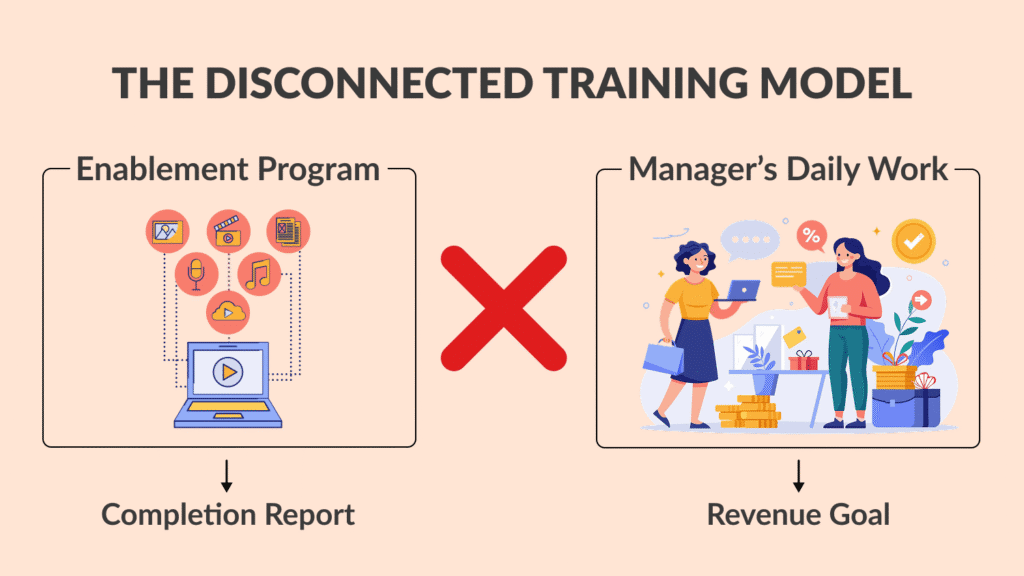
This disconnect has real consequences. It leads to situations like the one faced by Candace, a new partner of Cloud Kicks. She was enrolled in a standard onboarding program full of curated content, but almost a month went by before she felt she had a grasp of the job. Even after six months, she was struggling to meet expectations and was nowhere near closing her first deal. The content, while thorough, was often inaccessible or poorly timed. She would review material that didn’t apply to her immediate work, only to have to find and re-read it weeks later when it finally became relevant.
A New Philosophy: Outcome-Based Enablement
The limitations of traditional training call for a new approach. Enablement in Salesforce Partner Cloud is built on a different philosophy: instead of focusing on the input (a checklist of content to consume), the model starts with the output (the specific business impact or outcome you want to generate).
This shift is best illustrated by the thought process of Jose, the partner manager at Cloud Kicks. After realizing his new partner’s enablement experience might be the cause of her slow start, he re-architected his program by starting with the end goal and working backward.
- Step 1: From Vague Goal to Specific Outcome Jose began with a simple problem statement: “Shorten time to first deal”. He recognized this was too vague. To make it actionable, he defined a specific, measurable Outcome: “Partner closes their first deal in 60 days”. This was a clear goal that could be tracked directly in Salesforce by counting opportunities set to “Closed Won”.
- Step 2: Work Backward to Identify Milestones With the 60-day outcome set, Jose worked backward. He knew that closing a deal was an accumulation of many smaller accomplishments. Instead of waiting 30 days for a partner’s first call (as Candace had ), he identified the key behaviors, or Milestones, that would prove a partner was on the right track. These new milestones were also specific and measurable in Salesforce:
- Log 30 calls by day 10.
- Book one meeting by day 10.
- Send 20 emails by day 15.
- Step 3: Add Exercises to Support the Milestones
Only after defining the measurable outcomes and milestones did Jose select the content, or Exercises. He understood that partners needed the right training at the right time to hit these goals. He structured the program so the first 10 days focused only on content that built prospecting competence, such as videos on prospecting, slide decks on qualifying questions, and practice sales pitches. Content related to later-stage tasks, like negotiating, was deferred until it was relevant.
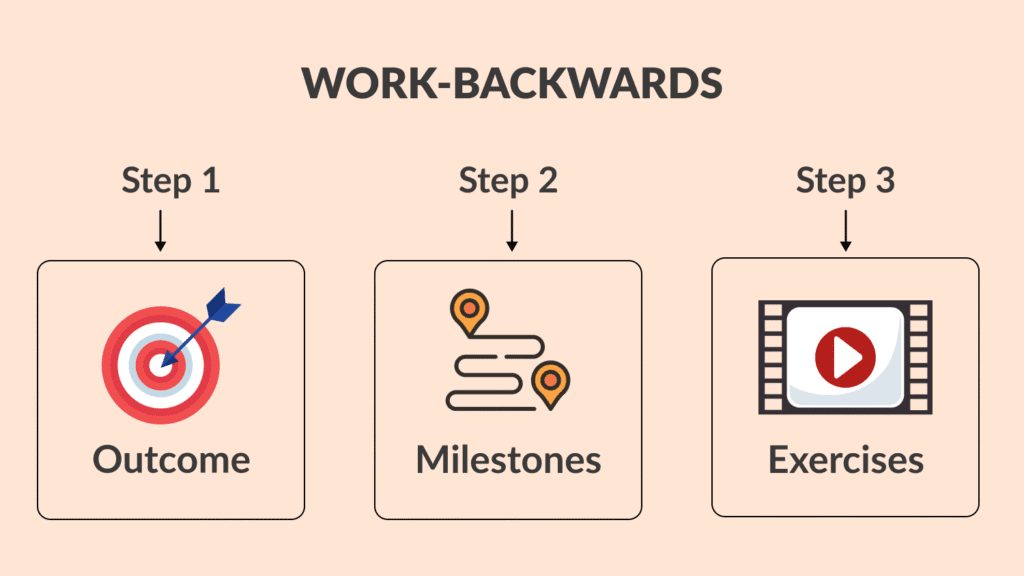
This outcome-based plan is designed to directly connect enablement activities to the revenue goal Jose is trying to achieve.
If you find this article interesting, we also recommend checking out the previous blog post in this series ⤵️
Salesforce Partner Cloud Fundamentals: How Partner Tracks Work
Applying the Model to Your Core Revenue Goals
The outcome-based model that Jose used for onboarding is a repeatable framework that can be applied to virtually any business outcome that affects revenue. By starting with a specific, measurable goal, you can adjust your channel sales programs to drive the precise behaviors you need to improve.
Here is how the model can be applied to the four major sales metrics:
- Ramp Time: As seen in the Cloud Kicks example, this model is perfectly suited for Ramp Time. The program was designed to solve the problem of new partners struggling to produce.
- Outcome: Partner closes their first deal in 60 days.
- Milestone: Partner logs 30 calls by day 10.
- Exercise: Partner completes content focused on prospecting and qualifying questions.
- Win Rate: The model can be used to improve a struggling Win Rate. If your win rate is 10% when it should be 15%, the theory might be that partners aren’t speaking with the right people. The program can be adjusted to fix this.
- Outcome: Partner increases win rate from 10% to 15%.
- Milestone: Partner books 20 meetings with contacts who are decision-makers.
- Exercise: Partner completes content that focuses on how to identify decision-makers within a prospect’s organization.
- Cycle Length: This framework is also ideal for shortening your Cycle Length. If your average deal cycle is 75 days but your target is 60 days, the problem may be that deals are stalling in the middle of the pipeline.
- Deal Size: Finally, the model can be used to increase your average Deal Size. If partners are closing deals below $50K because they are offering discounts too frequently and competing on price rather than value, you can adjust the enablement program to prioritize value-based selling.
- Outcome: Partner increases the average deal size to over $50K.
- Milestone: Partner sells on value, which can be measured by counting calls that use a value-based script.
- Exercise: Partner completes a training course and content focused on value-based selling.
| Revenue Goal | The Problem (Example) | The Measurable Milestone (The Fix) |
| Ramp Time | New partners struggle to produce. | “Partner logs 30 calls by day 10”. |
| Win Rate | Partners aren’t speaking to the right people. | “Partner books 20 meetings with decision-makers”. |
| Cycle Length | Deals are stalling in the middle of the pipeline. | “Partner improves mid-pipe activity”. |
| Deal Size | Partners are competing on price, not value. | “Partner sells on value (e.g., count calls using value script)”. |
How This Model Proves Its Own ROI
A significant advantage of this outcome-based framework is its built-in accountability, which allows you to prove the value of your enablement efforts and iterate on your strategy with real data.
Closing the Loop on ROI
The real power of this model is that it is fully trackable. Because the program’s outcomes and milestones are tied directly to specific, measurable data that already exists in Salesforce (like the number of calls logged, opportunities won, or average deal size), you can finally quantify the impact of your training. This model allows you to move beyond simple completion metrics and demonstrate the true ROI of your enablement programs by connecting them directly to the revenue outcomes they are designed to influence.
Iterate with Data, Not Guesswork
This data-driven approach also provides the flexibility to troubleshoot and make improvements. The specific metrics associated with each outcome, behavior, and content strategy help you monitor how well the adjustments are working.
You can use the built-in analytics to see where users are struggling or where the program theory is flawed. For example, let’s revisit the “Deal Size” scenario. Imagine your partners completed the value-selling training (the Exercise) and successfully made 10 calls without mentioning a discount (the Milestone), but the average deal size (the Outcome) still didn’t increase. This data tells you that your initial theory – that discounting was the sole cause of low deal sizes – might have been inaccurate.
Instead of guessing, you can now use this insight to adjust the program, perhaps focusing on a different behavior. This framework provides the flexibility and insight to respond to results and implement new strategies for achieving your business outcomes, all based on real data.
Conclusion: From Tracking Completion to Measuring Revenue
Salesforce Enablement provides the tools to finally adopt a true outcome-based strategy. This model fundamentally shifts the focus of your channel sales training. The primary question is no longer, “Did our partners complete the training?” but rather, “Did the training actually change their behavior and improve our revenue?”
By providing the analytics to track milestone and outcome completion directly against sales data, enablement leaders can prove the effectiveness of their strategy and iterate on it with data, not guesswork. This approach transforms partner enablement from a simple checklist into a powerful, flexible, and measurable engine for driving your company’s most important business outcomes.
Salesforce Partner Cloud offers many more features to enhance your experience, and we’re proud to be one of the top Salesforce partners for PRM, delivering full Partner Cloud implementations.
Reach out to us today to see how Partner Cloud can elevate your partner strategy.