
Audience Targeting in Salesforce Experience Cloud: How to Personalize What Users See
Not every user who visits your Experience Cloud portal needs to see the same thing. A partner in Germany, a customer in the US, a new employee on their first day, and a senior manager reviewing dashboards, they all have different needs, different contexts, and different reasons for being there. Showing everyone the same content is a missed opportunity at best and a source of friction at worst.
Audience targeting in Salesforce Experience Cloud gives you a practical way to solve this problem. Instead of building multiple portals or manually managing who sees what, you can define audience segments and tailor the experience, content, branding, page layouts, navigation, and more for each group. The result is a more relevant, focused, and useful portal for everyone who uses it, without needing to rebuild the site from scratch every time your needs evolve.
This guide explains how audience targeting works, what you can personalize, and how to apply it effectively in real-world scenarios.
What Is Audience Targeting in Salesforce Experience Cloud?
In Salesforce Experience Cloud, audiences are defined groups of users who share one or more characteristics drawn from profile data, user object fields, permissions, or other criteria you configure in Experience Workspaces.
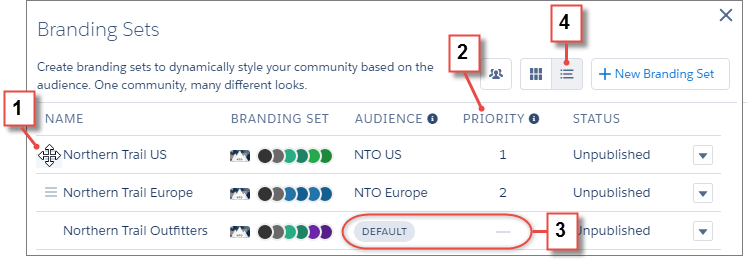
Once an audience is defined, you can assign it a different page variation, branding set, visible components, or navigation structure. Users who match the criteria automatically see the experience configured for them, everyone else falls back to the default.
The key idea is that audience targeting works as a layer on top of your existing site structure and there is no need to duplicate pages or build separate portals for each group.
Audiences can be built using a range of criteria, including:
- User object fields — country, city, company name, job title, department, and any other standard or custom text or picklist field on the User record
- Profile — the user’s Salesforce profile
- Permission sets — for more granular, role-based access logic
- Location — based on IP address (though User Object field criteria tends to be more accurate for geographic targeting)
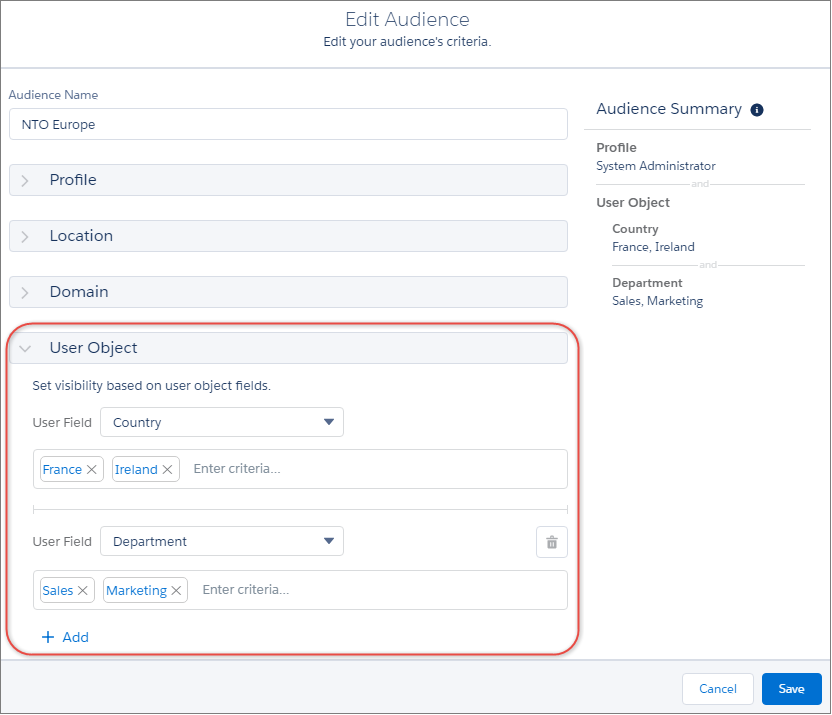
You can combine multiple criteria within a single audience definition, and users can belong to more than one audience simultaneously. When that happens, the priority you assign to each audience determines which experience takes precedence.
Why Audience Targeting Matters for Digital Experience
The value of audience targeting in Salesforce Experience Cloud goes beyond aesthetics. It directly affects how useful and usable your portal is for different groups of people.
- Relevance. When users land on a page and see content, tools, and resources that match their role and context, they engage more. They find what they need faster and are less likely to abandon the session out of frustration.
- Reduced noise. Portals that try to serve every user type with the same interface quickly become cluttered. Partners don’t need to see customer support content. New users don’t need advanced configuration guides. Salesforce audience targeting lets you surface the right information to the right people and keep everything else out of the way.
- Better UX without more complexity. Building separate sites for every segment isn’t scalable. Audience targeting lets your team manage one underlying portal while delivering meaningfully different experiences to different groups, reducing maintenance overhead while improving the end-user experience.
- Stronger engagement and conversion. Whether your goal is case deflection, partner enablement, member retention, or employee productivity, a personalized experience is more effective than a generic one. Dynamic content for different audiences, calls to action, and navigation paths help guide users toward the outcomes that matter to your business.
What You Can Personalize for Different Audiences
Audience targeting in Experience Cloud can be applied across several layers of the user experience:
Page variations. You can create different versions of the same page for different audiences. A homepage for partners might emphasize deal registration and co-marketing resources, while the same URL for customers shows support options and product documentation.
Branding sets. Different audiences can see different visual branding (logos, color schemes, banner images) and overall look and feel. This is particularly useful for multi-brand organizations or partner portals where co-branding is part of the relationship.
Content components. Individual components on a page (banners, announcements, resource lists, featured articles) can be shown or hidden based on audience membership. This lets you personalize sections of a page without building an entirely separate page for each group.
Navigation. Menu items and navigation structures can vary by audience. Users only see the sections of the site that are relevant to them, which reduces cognitive load and speeds up task completion.
Calls to action. Different user segments often require different next steps. A new user might be directed to onboarding resources. An existing customer might be shown an upsell opportunity. A partner might see a prompt to submit a deal. Audience targeting lets you configure these paths independently.
Visible resources and tools. Files, knowledge articles, community groups, and other resources can be surfaced selectively based on who is viewing the portal.
Common Audience Targeting Use Cases
Regional or Country-Based Personalization
Organizations operating across multiple geographies can display region-specific content, language preferences, local contacts, or compliance-relevant information. Using User Object field criteria, such as the Country field, provides a more reliable basis for geographic segmentation than IP-based location, which can be inconsistent.
Customer vs. Partner vs. Employee Portals
If you run a multi-purpose Experience Cloud site, audience targeting lets you differentiate the experience without fragmenting your Org. Customers see support and product resources. Partners see deal management tools and co-branded content. Employees see HR, IT, and internal processes. One site, multiple coherent experiences.
Onboarding Flows for New Users
First-time users often need guidance that experienced users find unnecessary. By identifying new users as a distinct audience, you can show them welcome content, step-by-step guidance, and introductory resources, and gradually transition them to the standard experience as they become more familiar with the portal.
Role or Department-Based Content
In employee or member portals, what’s relevant often depends on the user’s department, title, or internal role. A finance team member needs different resources than someone in operations or sales. User Object fields make it straightforward to define audiences along these lines.
Account Type or Company Tier Segmentation
For B2B portals, you might want to differentiate the experience based on account type: enterprise vs. SMB, premium vs. standard partners, or any other classification that exists in your Salesforce data model. This can drive personalized pricing information, dedicated support channels, or tier-specific resources.
Priority Content for Key Segments
Beyond showing or hiding content, audience priority allows you to control which experience loads first for users who belong to multiple audiences. This matters when a user’s primary relationship with your organization should define their experience, regardless of secondary audience memberships.
Best Practices for Setting Up Audience Targeting
- Start with your most impactful segments. Don’t try to build audiences for every possible user variation from day one. Start with the two or three segments that would benefit most from a differentiated experience and expand from there.
- Make sure your data supports your logic. Audience criteria are only as good as the underlying data. Before defining an audience based on a User Object field like Department or Country, verify that those fields are consistently populated and maintained in your Org. Gaps in data quality lead to inconsistent user experiences.
- Keep audience logic simple and readable. Complex nested criteria can be hard to maintain and harder to troubleshoot. Where possible, use clean, straightforward rules and document what each audience is intended to represent.
- Test each audience experience independently. Experience Builder allows you to preview the portal as a specific user or audience. Use this before going live to confirm that each segment sees exactly what you intended and nothing they shouldn’t.
- Avoid unnecessary fragmentation. Not every content difference needs a separate audience. If two groups are 90% similar, consider whether a single experience with minor component-level adjustments is a better approach than maintaining two distinct page variations.
- Establish a naming convention. As your audience’s number grows, clear and consistent naming by region, role, account type, or user segment becomes essential for long-term manageability.
When to Use Audience Targeting vs. When to Rebuild the Experience
Audience targeting is effective when the underlying structure of the experience is similar across groups, but the content, branding, or emphasis needs to differ. It works well when:
- The same navigation structure applies to all users, with minor variations
- Page layouts are broadly similar across segments
- The number of audiences is manageable (generally fewer than ten to fifteen distinct segments)
- Differences are content- or data-driven, not structural
There are situations, however, where a more substantial architectural change makes more sense:
- When two user groups need fundamentally different site structures, workflows, or feature sets, maintaining them as a single site with targeting logic can become unmanageable
- When the volume of audience-specific page variations grows to the point where maintenance overhead outweighs the benefits
- When security or data isolation requirements mean that certain users must be in completely separate environments
In these cases, building separate Experience Cloud sites, each tailored to its intended audience from the ground up, is often the cleaner long-term solution. The two approaches aren’t mutually exclusive: you might use audience targeting within each site to handle finer-grained Experience Cloud personalization.
How Advanced Communities Can Help
Effective audience targeting involves more than configuring rules — it requires understanding your user segments, mapping the right data to the right criteria, and structuring the experience so personalization adds clarity rather than complexity.
Advanced Communities works with organizations to design and implement Experience Cloud portals built around the people who use them. Whether you’re working on a partner portal, a customer support site, or a member community, we’d be glad to talk through how audience targeting fits your needs.
Conclusion
Audience targeting in Experience Cloud is one of the most practical tools available for delivering a personalized digital experience without building multiple sites. By defining audiences based on user data and assigning different content, branding, and page variations to each group, you can make your portal more relevant, more usable, and more effective for every person who visits it.
Done well, it’s largely invisible to the end use. They simply see a portal that makes sense for them. That’s the goal. If you’d like to explore how audience targeting could work for your portal, get in touch with our team.
FAQ
1. What is audience targeting in Salesforce Experience Cloud?
Audience targeting is a built-in capability in Salesforce Experience Cloud that lets administrators define user segments called audiences, and deliver different content, page variations, branding sets, or navigation to each group. Users are matched to audiences based on criteria such as their User Object field values, profile, or permission sets.
2. Can I show different pages to different users in Experience Cloud?
Yes. Experience Cloud supports page variations, which allow you to create multiple versions of a page and assign each to a specific audience. Users see the version that corresponds to their audience, while users who don’t match any audience see the default page.
3. What data can be used to define audiences in Salesforce?
Audiences can be defined using a wide range of criteria, including standard and custom fields on the User Object (such as Country, Department, Title, or Company Name), the user’s Salesforce Profile, and permission sets. You can combine multiple criteria within a single audience definition for more precise targeting.
4. When should I use audience targeting instead of separate portal pages or sites?
Audience targeting is the right approach when your user groups need similar site structures but different content, branding, or emphasis. If two groups require fundamentally different architectures, workflows, or feature sets, building separate Experience Cloud sites is often a better long-term solution. For most organizations, the practical answer is some combination of both.