
Nonprofit Cloud VS NPSP: Exploring the Key Differences
Last Updated: February 17, 2026
We’re hearing a lot of buzz about transitioning to Nonprofit Cloud, especially from nonprofits who previously used Salesforce’s Nonprofit Success Pack (NPSP). They want to understand the difference between the solutions and the worth of switching to a new cloud.
Some even suggest that the Salesforce platform is gradually phasing out NPSP and considering retirement for the package. So, in this blog, we are exploring this topic, providing you with an understanding of the Nonprofit Cloud vs NPSP differences and the benefits of each solution.
Quick answer:
- NPSP is usually the better fit for nonprofits with simpler processes, limited budgets, smaller teams, and established workflows that already work well.
- Nonprofit Cloud fits organizations planning to scale, adopt a modern Salesforce data model, and manage more complex programs, services, and fundraising strategies.
- The hardest part of migration isn’t technology — it’s change: data mapping, process redesign, integrations, and staff training.
Not sure which path fits your org?
Talk to our experts or request an assessment → Contact us
What Actually Happened?
Salesforce introduced the Nonprofit Starter Pack (later Nonprofit Success Pack, or NPSP) as a complementary solution to provide nonprofits with fundraising and relationship management tools that meet their needs.
Years later, Salesforce introduced Nonprofit Cloud as a broader industry solution that was meant to expand and streamline the core capabilities of the Salesforce platform for nonprofits. It’s designed to support program delivery, case management, and outcomes tracking using a new data architecture.
What Salesforce Positions Today
Salesforce positions Nonprofit Cloud as the strategic long-term platform for nonprofits adopting industry data models, while NPSP remains available and supported for organizations that prefer its structure.
Is Salesforce Moving Away From NPSP?
We don’t think so. As of early 2026, Salesforce continues to support NPSP. However, strategic innovation is focused primarily on Nonprofit Cloud.
Here are the main reasons why NPSP will likely continue to be supported in the future:
- According to official Salesforce information, NPSP is currently used by thousands of organizations, and Salesforce will continue to support it.
- NPSP is an open-source product, so even if the pack is retired some day users would still be able to install it in their orgs. So, it just can’t be retired at all.
- The official Salesforce blog post also confirms that Salesforce will maintain support for existing offerings (including NPSP).
- The idea of migrating is intimidating for nonprofits that have been using the Nonprofit Success Pack for quite some time. Considering that migration to a new system requires time, effort, and budget, most nonprofits will continue using NPSP.
After all, for many organizations, it’s still not clear how seamless the current switching process into Nonprofit Cloud is. As a result, people will likely continue using what they’re familiar with, avoiding the risks associated with migrations.
So, let’s see what the future holds. But we think that even if NPSP is retired someday, it won’t happen anytime soon.
Salesforce Experience Cloud as a Nonprofit and Donation Management Solution

Nonprofit Cloud vs NPSP: Main Differences Between the Solutions
In the Salesforce Nonprofit Cloud vs NPSP comparison, both solutions serve nonprofits that use Salesforce, and both were built specifically with nonprofit organizations in mind to address the common challenges associated with all nonprofit processes, such as fundraising, accounting, program management, grantmaking, etc.
While some of the use cases are similar, Nonprofit Cloud data model and other areas are radically different and more complex than NPSP in most of the key ways.
| Area | NPSP | Nonprofit Cloud |
|---|---|---|
| Core architecture | Managed package on Sales Cloud | Native industry cloud architecture |
| Data model | Households + Contacts | Person Accounts + Party Relationship Groups |
| Fundraising | Opportunities + Recurring Donations | Multiple fundraising apps and objects |
| Program management | NPSP Program Management | Industry program model |
| Case management | NPSP Case Plans | Care Plans + Interaction Summaries |
| Reporting | Standard Salesforce reporting | Advanced analytics ecosystem |
| Customization complexity | Moderate | High |
| Admin skill requirements | Admin-level | Admin + architect-level |
| Implementation effort | Lower | Higher |
| Migration complexity | Not required if staying | Requires transformation |
| Integration impact | Typically stable | Often requires redesign |
| Conpany size | Small–mid nonprofits | Complex, scaling organizations |
Here are also key differences between Nonprofit Cloud and the NPSP package you need to keep in mind:
- Package vs platform solution: NPSP functions as a managed package installed on top of Sales Cloud, adding fields, automation, and nonprofit-specific tools that can be customized or extended by admins and developers. Nonprofit Cloud, in contrast, is built as a native industry solution within the Salesforce platform rather than an add-on. This shifts organizations from extending a CRM foundation to working within a predefined industry architecture. The result is stronger standardization and scalability, but typically less flexibility for quick structural changes and a higher level of implementation effort.
- Platform scope and operational complexity: NPSP extends the core capabilities of Sales Cloud, while Nonprofit Cloud is designed to support broader and more complex operational processes across fundraising, program delivery, and stakeholder management. For teams, this means moving from a primarily CRM-centered system to a more comprehensive operational platform. Organizations gain more structured tools for complex workflows, but also face increased configuration complexity and a steeper learning curve.
- Technology stack and skill requirements: Nonprofit Cloud incorporates OmniStudio and relies heavily on platform tools such as Flows, Business Rules Engine, Lightning Web Components, Tableau, and Data Cloud. This expands the technical scope of system configuration and maintenance compared to a typical NPSP environment. Teams benefit from more powerful automation and orchestration capabilities, but success depends on having the right technical expertise or partner support to manage and evolve the solution.
- Scale of the standard data model: When Nonprofit Cloud is enabled, a larger number of standard objects become available by default. This introduces a more extensive data structure than what organizations typically manage in NPSP. While the expanded model provides a foundation for growth and advanced functionality, it also increases the complexity of system navigation, configuration, and governance, especially for organizations that may not need the full scope of available components.
- Households vs Person Accounts: NPSP organizes individuals using the Household Account model, grouping related contacts under a shared household structure. Nonprofit Cloud uses Person Accounts combined with Industry Common Components and Party Relationship Groups to represent individuals and their relationships. This fundamentally changes how constituent data is structured and managed. Organizations gain a more flexible industry-standard model for representing relationships, but the shift requires data transformation, process redesign, and user retraining during migration.
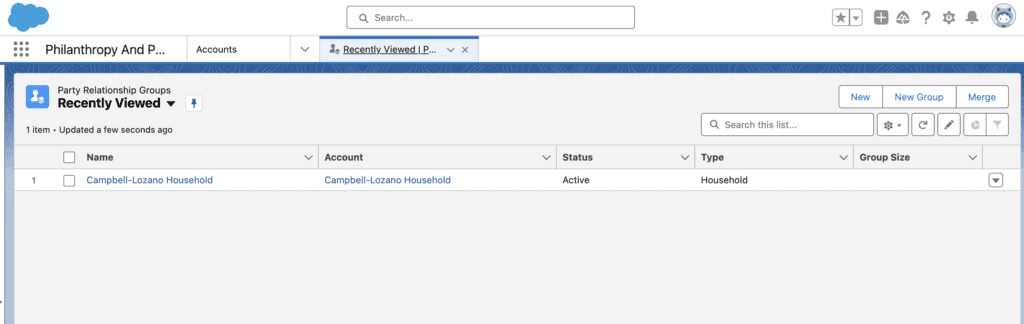
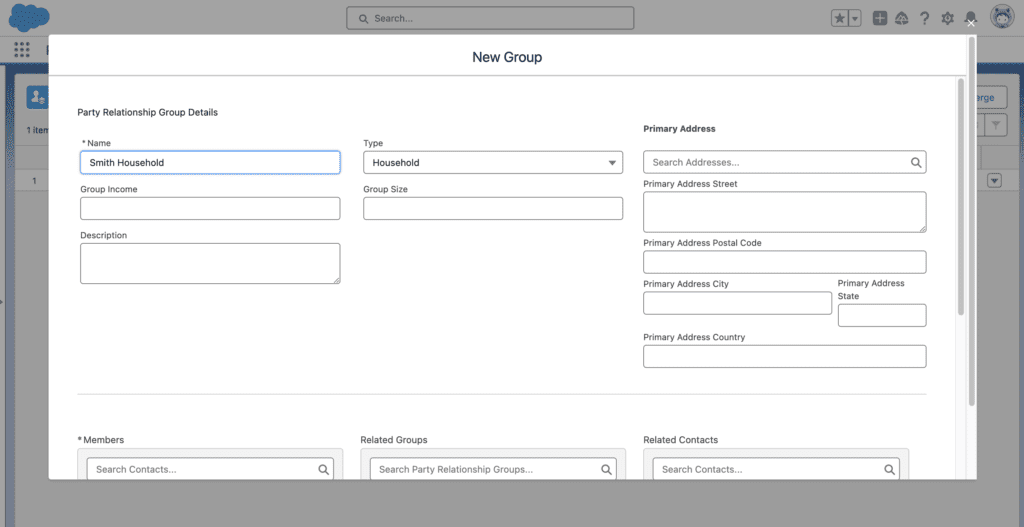
- Address management approach: NPSP includes built-in functionality for managing multiple addresses at the household level, allowing organizations to track shared and individual addresses within a single structure. Because Nonprofit Cloud does not use the Household Account model, address management is handled differently and may require alternative configuration approaches. Organizations gain more flexibility in how address data can be modeled, but teams may need to redesign existing processes and adjust reporting or communication workflows that previously relied on household-based address management.
- Relationship visualization: Nonprofit Cloud introduces the Actionable Relationship Center, a visual interface that displays connections between individuals, organizations, and stakeholders in an interactive graph format. This provides teams with a more intuitive way to understand complex relationship networks compared to the traditional record-based view used in NPSP. The feature can improve visibility into engagement patterns and collaboration opportunities, though it requires configuration and user onboarding to fully leverage its capabilities.
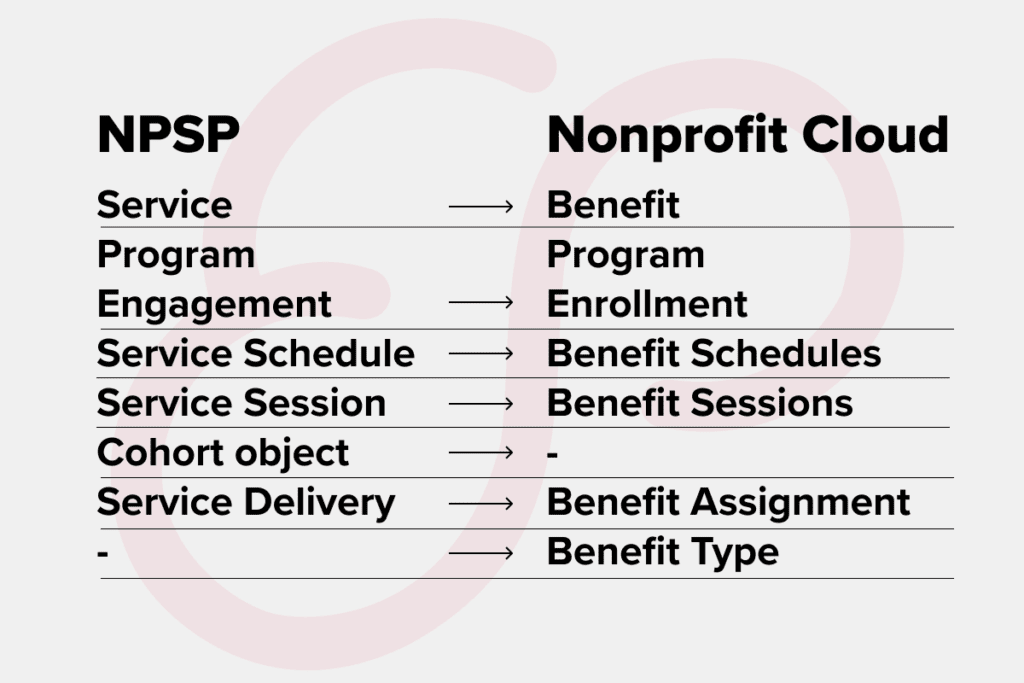
- Program management model changes: Nonprofit Cloud provides a redesigned program management framework with a different structure of objects and terminology compared to NPSP. While both solutions support program tracking, the Nonprofit Cloud model is built to align with the broader industry data architecture. For organizations, this means program processes, reporting logic, and object relationships may need to be reconfigured or relearned. The updated model can support more complex service delivery scenarios, but transitioning to it typically requires process alignment and user training.
Program Management Objects Comparison
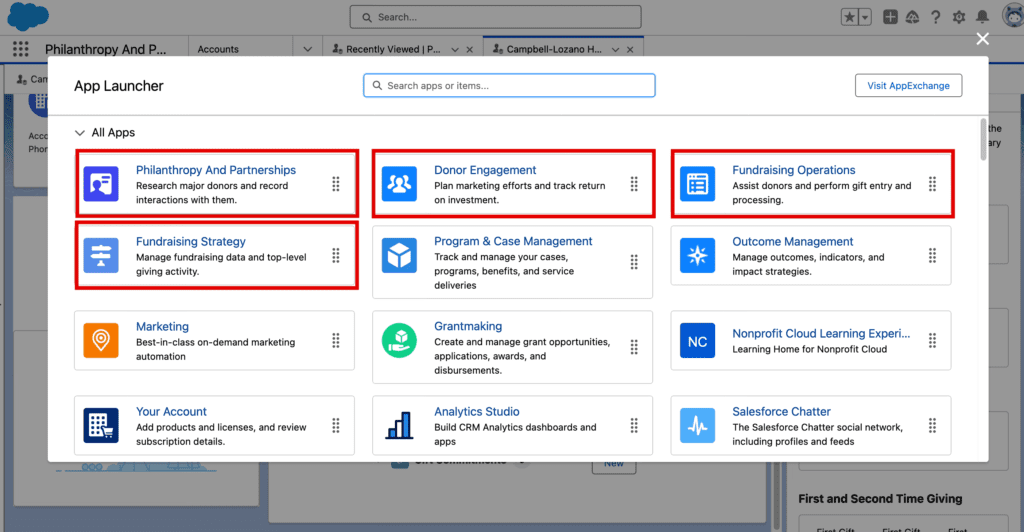
Fundraising management has a completely different data model than NPSP. Nonprofit Cloud comes with 4 pre-built Fundraising apps: Philanthropy And Partnerships, Fundraising Strategy, Donor Engagement, and Fundraising Operations each of which consists of a whole set of new objects that make it a complex solution. In NPSP fundraising and donors are managed through Opportunities and Recurring Donations objects.
- The Case Management object workflow in the new Nonprofit Cloud is similar to that in the NPSP package. However, there are also some differences in object names. For instance, Case Plans in NPSP become Care Plans in the new Nonprofit Cloud. The Client Notes object in NPSP has been replaced with the Interaction Summary object in Nonprofit Cloud.
As of now, V4S is compatible with Nonprofit Cloud. To investigate this further, we created a new org with Nonprofit Cloud and installed the V4S package. The package appeared to be working correctly. If your client has already been using NPSP with V4S, they will need to do data migration as Nonprofit Cloud requires a new org and cannot be used with NPSP.👉 Not sure which path fits your org?
Talk to our experts or request an assessment → Contact us
How to choose: decision checklist
Ask your team:
- Do we have complex programs or service delivery workflows?
- Are our processes highly customized today?
- Do we have an internal Salesforce admin or architect?
- Are we planning major growth or scaling?
- Do we rely on many integrations?
- Are we ready to retrain staff and redesign workflows?
- Do we need advanced analytics or outcome tracking?
- Is our current NPSP implementation limiting us?
- Do we have budget and capacity for transformation?
- Are we comfortable changing the data model?
Migration considerations (if you move from NPSP)
Data & mapping risks
The most complex part of migration typically involves restructuring how core data is modeled. Organizations must transform Household-based records into Person Accounts, redesign relationship structures, and ensure historical donation data remains accurate and usable. Integrations that depend on the existing data model may also require adjustments or rebuilding. Because these changes affect reporting, automation, and user workflows, careful data mapping and validation are essential to avoid downstream operational issues.
Timeline & phases
Migration to Nonprofit Cloud generally follows a structured progression that begins with discovery and solution design, followed by data mapping, configuration, testing, user preparation, and production rollout. However, the actual timeline varies widely depending on system complexity, the number of integrations, data quality, and organizational readiness for change. Projects often take longer when significant process redesign or data transformation is required.
Training & change management
Successful adoption depends not only on technical implementation but also on how well teams adapt to the new operating model. Staff must learn updated data structures, navigation patterns, and workflows, while organizations often need to redefine internal processes and governance practices. Establishing a clear support model and investing in user enablement helps reduce resistance, improves data quality, and ensures the platform delivers long-term value.
Planning a migration?
We can help with roadmap, data mapping, and implementation → Contact us
Salesforce Nonprofit Cloud: resources for learning
There are plenty of cool features in the Salesforce Nonprofit Cloud but also lots of learning as the new platform includes a collection of components and tools that are not available in NPSP. Before starting your journey on Nonprofit Cloud, you’ll need some time for learning. Don’t ignore getting a Learner Org to play with new features and spend time exploring Trailhead.
Here are some resources that will help you on your Salesforce Nonprofit learning journey:
- Nonprofit Learning Resources: Quick Look
- Nonprofit Vision and Value Mapping
- Stakeholder Management in Nonprofit Cloud
- Manage Programs with Nonprofit Cloud
- Manage Client Outcomes with Nonprofit Cloud Case Management
- Nonprofit Cloud for Fundraising Quick Look
- Salesforce Nonprofit Cloud Documentation
Conclusion
In conclusion, as we’ve explored the key differences between Nonprofit Cloud vs NPSP, it’s evident that each has its unique strengths and features. In this battle, Nonprofit Cloud introduces more complexity and additional tools, while NPSP provides a simpler approach.
The decision between two Salesforce Nonprofit options depends on the specific needs and preferences of your nonprofit organization. Whichever path you choose, we can support you with the implementation, migration from NPSP to Nonprofit Cloud, or optimization of your existing processes. Book a call with us to discuss your situation — we’re always happy to help.
FAQ
1. What is the Difference Between NPSP and Nonprofit Cloud?
The main difference between Salesforce Nonprofit Cloud and NPSP is that the former comes as a bundle of different, more up-to-date, and modernized solutions. Nonprofit Cloud is built directly into the Salesforce platform, while NPSP is a basic solution for donor and partner management. This makes it ideal for some smaller businesses. Another important difference is that NPSP requires installation, while Nonprofit Cloud comes with most Salesforce licenses.
2. Do I need a new org to move to Nonprofit Cloud?
In most cases, yes — organizations implement Nonprofit Cloud in a new environment rather than converting an existing NPSP org. This approach helps ensure a clean data model, reduces technical debt, and supports a smoother transition to the new architecture.
3. Is Salesforce NPSP Going Away?
As a matter of fact, Salesforce NPSP is not going anywhere. Salesforce decided to support this solution further and make it available for some groups of users.
4. What are the biggest migration risks?
The main risks typically involve data transformation, process redesign, integration adjustments, and organizational change management. Careful planning, testing, and user preparation are critical to reducing disruption during the transition.
5. What are the Benefits of Salesforce Nonprofit Cloud?
There is a plethora of benefits of Salesforce Nonprofit Cloud. First, it leverages advanced analytics and reporting that lets organizations make data-driven decisions. Besides, the Nonprofit Cloud provides a 360-degree view of donors, volunteers, and beneficiaries, has fundraising tools, provides full-scale volunteer management, and automates communication with donors, volunteers, and sponsors.
6. How do licensing and costs differ?
Costs vary depending on licensing structure, implementation scope, and required customization. Nonprofit Cloud projects often involve higher upfront investment but may provide broader functionality for complex operations.
7. Is Salesforce for Nonprofits Really Free?
Salesforce for Nonprofits is not completely free. It provides discounts and substantial benefits at a low cost, especially for small to mid-sized nonprofits.
8. Is NPSP still supported?
Yes, Salesforce continues to support NPSP and maintain it for existing users. However, most new innovation and long-term platform development are focused on Nonprofit Cloud.