
Salesforce Partner Cloud Glossary
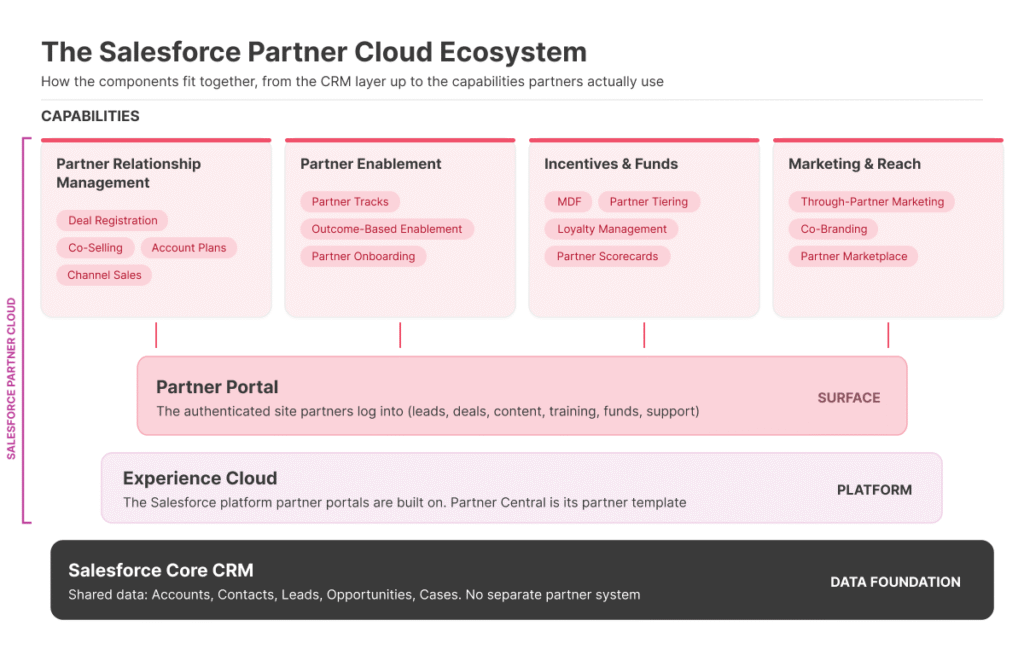
Salesforce now sells its partner products under the name Partner Cloud, which it describes as a cluster of products rather than a single application. The older words never went away, though. Open three internal documents and you will find PRM in one, Partner Central in another, and “the partner portal” in the third, often describing the same site. Add MDF, deal registration, and outcome-based enablement, and the vocabulary alone slows a project down.
This Salesforce Partner Cloud glossary is a reference for that vocabulary, with a plain definition and the reason each concept exists.
This glossary is regularly updated as Salesforce introduces new Partner Cloud capabilities.
Jump to a letter: A · C · D · L · M · O · P · T
How This Salesforce Partner Cloud Glossary Works
Terms are listed alphabetically rather than grouped by product, because that is how people look them up. Every entry follows the same shape: a short definition, what the concept is for, and related terms so you can follow a thread across the ecosystem. Definitions describe each concept inside Salesforce generally, not in a specific release.
Terms & Definitions
A
Account Plans
A joint plan that a vendor and a partner build for a named end customer or a set of target accounts. It records the revenue goal, the opportunities in play, the owner on each side, and the activities both sides commit to.
Account plans exist because co-selling falls apart when neither side knows who is doing what. Channel teams usually reserve them for strategic partners and revisit them quarterly against live pipeline data.
Related terms: Co-Selling, Partner Tiering, Partner Scorecards
C
Channel Partner
Any external company that sells, refers, resells, distributes, or implements your product instead of your own sales team. Resellers, VARs, distributors, agents, brokers, referral partners, and implementation partners all sit under this label.
In Salesforce, a channel partner is normally an Account with partner users attached. That structure is what makes controlled data sharing possible: the partner sees its own leads, opportunities, and cases, and nothing belonging to another partner.
Related terms: Channel Sales, Partner Portal, Partner Relationship Management (PRM)
Channel Sales
The go-to-market model where revenue is generated by third parties rather than direct sellers. Companies choose it to enter new regions or segments without hiring a local sales force, and to reach buyers who prefer purchasing through a familiar supplier.
Channel sales changes what you measure. Instead of quota per rep, channel teams track partner-sourced versus partner-influenced revenue, registration-to-close rates, and how much pipeline each tier contributes.
Related terms: Channel Partner, Deal Registration, Co-Selling
Co-Branding
Marketing material that carries both the vendor’s and the partner’s identity: logos, messaging, and often a partner-specific call to action. The vendor supplies the template and the approved claims; the partner adapts contact details and local positioning.
Co-branding matters because buyers frequently trust the local partner more than the global brand. It appears alongside through-partner marketing and MDF, since the same campaign kit is what partners spend their funds activating.
Related terms: Through-Partner Marketing, MDF, Partner Enablement
Co-Selling
A single opportunity worked jointly by a vendor rep and a partner rep, with shared visibility into activity, next steps, and forecast. It applies when the partner owns the customer relationship but the vendor brings product depth, or the reverse.
The practical challenge is data. Co-selling works only when both sides look at the same opportunity record rather than trading spreadsheets. For example, a distributor holds the customer relationship while your solution engineer joins the technical evaluation, both updating the same record.
Related terms: Deal Registration, Account Plans, Channel Sales
D
Deal Registration
The process by which a partner submits a deal it has sourced so the vendor can review, approve, and protect it. An approved registration typically grants exclusivity on that opportunity for a defined period, plus a margin or discount.
Deal registration is the main defence against channel conflict. For example, a reseller registers an account before the first meeting; once approved, the vendor’s own reps see it flagged and stand down.
Related terms: Channel Sales, Co-Selling, Partner Portal
L
Loyalty Management
A Salesforce product for running points, rewards, and membership tier programs. In a partner context it rewards behaviour rather than only revenue: completing certifications, registering deals early, submitting clean claims, attending enablement sessions.
It becomes relevant once a program outgrows a simple rebate. If you want partners to earn redeemable credits and see their balance in the portal without emailing the channel team, this is the component that handles it.
Related terms: Partner Tiering, Partner Scorecards, MDF
M
MDF (Market Development Funds)
Money a vendor sets aside for partners to spend on marketing activity: events, paid campaigns, content, local advertising. The lifecycle runs from allocation, through a partner request, to approval, execution, and a claim with proof of performance.
MDF buys demand generation you would otherwise fund yourself, in markets where the partner has better reach. It is one of the most commonly automated portal processes, because manual approvals and email claims are where budgets leak. For example, a gold-tier reseller requests funds for a regional event, then claims against it with attendee numbers and generated leads.
Related terms: Through-Partner Marketing, Co-Branding, Partner Tiering
O
Outcome-Based Enablement
An enablement model that measures partner progress against business results rather than course completion. Programs define an outcome, break it into milestones, and attach content to each milestone. Milestones are tracked from real CRM activity such as calls logged, meetings booked, or opportunities advanced.
The reason for the shift is simple: a partner can finish every module and still never register a deal. For example, the outcome is a first closed deal within 90 days, and the milestones are 20 logged calls and two qualified opportunities.
Related terms: Partner Tracks, Partner Enablement, Partner Scorecards
P
Partner Central
The Experience Cloud site template purpose-built for partner portals. It ships with the structure most channel programs need out of the box: lead and opportunity management, deal registration, campaign and file access, and a partner-oriented navigation layout.
Partner Central is a starting point rather than a finished product. Teams use it to stand up a working portal quickly, then extend it with custom components, branding, and additional objects.
Related terms: Partner Portal, Experience Cloud, Partner Cloud
Partner Cloud
The name Salesforce gives its portfolio of partner products. It is built around two licensing editions, Partner Relationship Management and Partner Ecosystem Management, with Channel Revenue Management sold alongside them. Salesforce positions all three as add-ons to Sales Cloud rather than part of it.
Most organizations adopt one piece first, usually a portal with deal registration, then add enablement, funds, and incentives as the program matures. Salesforce Partner Cloud runs on the same platform as your CRM, so partner data lives beside customer data.
Related terms: PRM, Partner Portal, Partner Central, Partner Tracks
Partner Enablement
The ongoing work of making partners capable of selling, positioning, and supporting your product: training, certification, playbooks, competitive material, demo assets, and access to experts. It runs for the life of the relationship.
Enablement is what separates a partner list from a partner ecosystem. A signed agreement produces nothing on its own; sustained enablement is how a mid-tier reseller becomes a partner that closes deals without hand-holding from your channel manager.
Related terms: Partner Onboarding, Outcome-Based Enablement, Partner Tracks
Partner Marketplace
A public-facing catalogue where customers can find partners, their offerings, or their apps and services, and often start a transaction. Salesforce’s own AppExchange is the familiar example.
Vendors build one when the ecosystem grows past the point where an internal team can match every buyer to the right partner. It is customer-facing by design, which is the clearest difference from a partner portal.
Related terms: Partner Portal, Channel Partner, Co-Branding
Partner Onboarding
Everything between a signed partner agreement and the partner’s first productive activity: account and user setup, portal access, legal and compliance steps, initial training, and introductions to the channel team.
Onboarding has an outsized effect on program results, because a partner that stalls in week two rarely recovers. Well-run programs treat it as a defined journey with owners and deadlines, not a folder of documents sent by email.
Related terms: Partner Enablement, Partner Portal, Partner Tracks
Partner Portal
The authenticated site partners log into for leads, opportunities, deal registration, content, training, funds, and support. On Salesforce it is built with Salesforce Experience Cloud and shares data directly with the CRM underneath.
The portal is where a partner program becomes visible to the people it serves, and its quality usually determines adoption. If partners cannot find the price list in two clicks, they go back to emailing your channel manager.
Related terms: Partner Central, Experience Cloud, Deal Registration
Partner Relationship Management (PRM)
Both a discipline and a software category. As a discipline, PRM covers the processes for recruiting, onboarding, enabling, and managing indirect sales partners. As software, it means the systems supporting those processes, and it is the historical name for what Salesforce markets today within Partner Cloud.
The term is also a specific licence inside the Partner Cloud portfolio. When someone says “our PRM”, clarify whether they mean the program, the portal, or the licence.
Related terms: Partner Cloud, Partner Portal, Channel Sales
Partner Scorecards
A reporting view of how a partner performs against agreed measures: registered and closed deals, revenue, certification coverage, enablement progress, MDF utilization, service metrics.
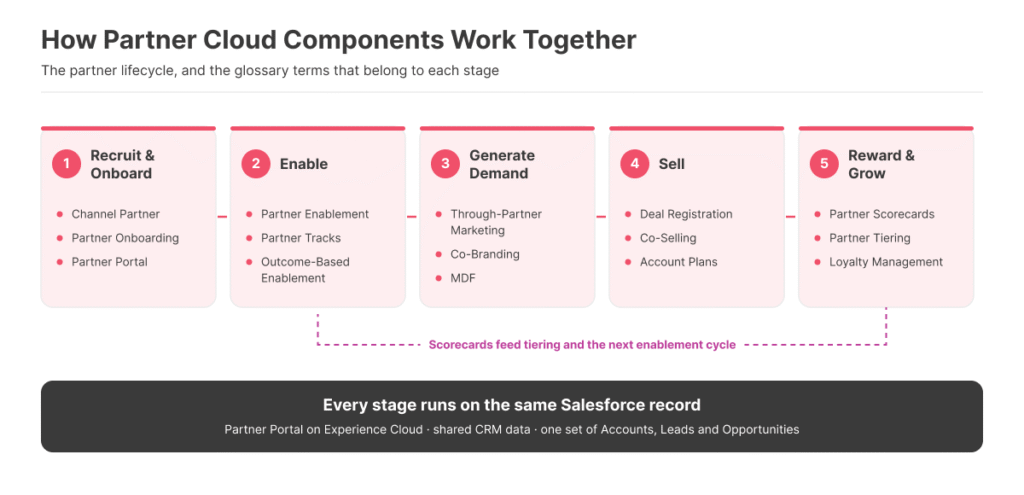
Scorecards give both sides an objective basis for a quarterly business review, and they feed tiering decisions. Sharing them inside the portal, rather than as a quarterly attachment, tends to change partner behaviour more than any incentive.
Related terms: Partner Tiering, Account Plans, Outcome-Based Enablement
Partner Tiering
Segmenting the partner base into levels, commonly registered, silver, gold, and strategic, each with defined entry requirements and differentiated benefits such as margin, lead flow, MDF access, or dedicated support.
Tiering exists because partner ecosystems follow a steep distribution curve, and treating every partner identically wastes budget on the ones producing nothing. It also gives smaller partners a visible path upward. For example, gold status might require two certified consultants and a revenue threshold, unlocking a higher margin and MDF eligibility.
Related terms: Partner Scorecards, MDF, Loyalty Management
Partner Tracks
Salesforce’s name for enablement programs delivered to partner users inside the partner site. A track is built from an outcome, the milestones leading to it, and the exercises (videos, decks, documents, lessons) that build the required skill.
Tracks are the mechanism behind outcome-based enablement in Partner Cloud. Because milestones are measured against activity that already exists in the CRM, a channel manager can see whether a program produces behaviour change.
Related terms: Outcome-Based Enablement, Partner Enablement, Partner Onboarding
T
Through-Partner Marketing
Campaigns created by the vendor and executed by partners under their own brand and to their own audiences. The vendor supplies templates, landing pages, email sequences, and offers; the partner runs them locally, often funded by MDF.
It scales demand generation across markets a central marketing team cannot cover credibly. The recurring difficulty is attribution: knowing which partner-run campaign generated which registered deal. That is why these programs get pulled into the same platform as deal registration.
Related terms: Co-Branding, MDF, Partner Marketplace
Frequently Confused Terms
- Partner Cloud vs PRM. PRM is the older and narrower term: the discipline of managing partners, and the software supporting it. Partner Cloud is the current portfolio name, covering PRM plus enablement, incentives, marketplace, and channel revenue capabilities. PRM also survives as a licence inside that portfolio, which causes most of the confusion.
- Partner Portal vs Experience Cloud. Experience Cloud is the platform for building authenticated digital experiences on Salesforce. A partner portal is one thing you build with it, alongside customer communities, member portals, and help centres.
- Partner Enablement vs Partner Onboarding. Onboarding is the finite first stage, with a clear end point. Enablement continues for the life of the relationship, keeping a partner effective as your product and market change. Onboarding is a subset of enablement, not a synonym.
- Partner Marketplace vs Partner Portal. A marketplace faces customers and helps them discover partners or partner offerings. A portal faces partners and helps them do business with you.
- Partner Central vs Partner Portal. Partner Central is a specific Experience Cloud template. A partner portal is the general concept, and it can be built on that template, on another, or entirely custom. Every Partner Central site is a partner portal; not every partner portal uses Partner Central.
Final Thoughts
Salesforce keeps expanding the Partner Cloud footprint, and the terminology moves with it. Capabilities get bundled, renamed, or absorbed into new licences, while older terms accumulate alongside the new ones.
Use this Salesforce Partner Cloud glossary as a working reference: check a definition before a requirements workshop, align vocabulary with your channel team, or send it to a stakeholder who needs to know where deal registration ends and enablement begins. If you are moving off an older setup, our guide on how to migrate from Salesforce PRM to Partner Cloud covers the audit and transition steps.
Need help building a modern Salesforce Partner Portal?
Advanced Communities helps organizations design and implement scalable Partner Cloud solutions on Salesforce Experience Cloud.
FAQ
1. What is Salesforce Partner Cloud?
Salesforce’s portfolio of partner products, built around the Partner Relationship Management and Partner Ecosystem Management editions, with Channel Revenue Management alongside them. All are add-ons to Sales Cloud.
2. Is Partner Cloud the same as PRM?
Not exactly. PRM is the underlying discipline and the historical product name, and also one of the licences inside Partner Cloud, which is the broader portfolio around it.
3. What is Deal Registration?
A partner submits a deal it has sourced so the vendor can approve and protect it, usually granting exclusivity plus an agreed margin. It exists to prevent channel conflict.
4. What is Partner Enablement?
The ongoing work of making partners capable of selling and supporting your product: training, certification, playbooks, assets, expert access. Unlike onboarding, it never finishes.
5. What is Partner Central?
The Experience Cloud site template designed for partner portals. It provides standard channel functionality out of the box and is usually extended with custom components and branding.
6. What is MDF?
Market Development Funds are vendor budgets allocated to partners for marketing activity, managed through a request, approval, execution, and claim cycle.
7. What is Partner Marketplace?
A customer-facing catalogue where buyers discover partners, their services, or their apps, and often begin a transaction. That customer focus separates it from the portal.
8. What is the difference between Partner Portal and Experience Cloud?
Experience Cloud is the platform for building authenticated Salesforce sites. A partner portal is one type of site built on it.